Introduction
A customer sends back the same defective part for the third time. Your team sorts the batch, reworks it, and ships a replacement. Two months later, the complaint returns. Fixing the symptom never touched the cause.
An 8D report is the structured, team-based record of how an organization contains a problem, finds and verifies its root cause, implements corrective action, and prevents recurrence. This article explains how 8D relates to ISO 9001, what each discipline involves, how to prepare the report, and why 8D is not itself a mandatory ISO 9001 form.
Key Takeaways
- An 8D report records a real investigation, not a form completed for an auditor.
- ISO 9001 prescribes neither the 8D method nor a universal template.
- Strong reports rest on evidence, verified causes, named owners, and effectiveness checks.
- Reserve a full 8D for serious, recurring, customer-related, or complex issues.
What Is an 8D Report in ISO 9001?
Definition and purpose
"8D" means Eight Disciplines. ASQ describes 8D as a structured problem-solving method for identifying, correcting, and eliminating problems, with corrective action based on root cause. Some organizations add an initial D0 planning step.
The method and the report are different things. The method guides the work. The report preserves the team, evidence, decisions, responsibilities, and results in chronological order.
How 8D relates to ISO 9001
ISO 9001:2015 Clause 10.2 expects an organization to react to a nonconformity and evaluate whether action is needed to eliminate its causes. It then expects the organization to implement that action, review its effectiveness, and update risks and the QMS where necessary. It also requires retained documented information on the nonconformity, the actions taken, and the results.
Check the current edition of the standard, since ISO published ISO 9001:2026 in September 2026 and your registrar will set transition expectations.
ISO 9001 does not require 8D or any particular format. 8D is one practical way to organize and demonstrate corrective-action work. Customers may add their own requirements: Ford's customer-specific requirements for IATF 16949, for example, recommend 8D.
When to use 8D
Good triggers include:
- Serious or recurring nonconformities
- Customer complaints and warranty issues
- Supplier defects
- Safety or regulatory concerns
- Problems that need several functions to solve
A simple, isolated error usually needs only a shorter corrective-action record.
What the report typically contains
- Report ID and issue description
- Affected product or process
- Containment status
- Team members
- Evidence and root cause analysis
- Action owners and due dates
- Effectiveness results and document updates
- Approvals and closure
ASQ publishes an example 8D template, but it is only an example. Adapt fields to your QMS and customer requirements.
The 8 Disciplines in an ISO 9001 8D Report
D0: Prepare and plan
D0 screens the issue and decides whether a full 8D is proportionate. Ford defines it as evaluating the need for the process and providing an emergency response if needed. Set scope, target dates, and resources. Respond at once to any immediate risk to customers or safety.
D1: Form the team
Build a cross-functional team with process knowledge, technical expertise, and authority to make decisions. Include affected functions and, where relevant, suppliers. Name a team leader and define who does what.
D2 and D3: Describe the problem and contain it
D2 defines the issue in measurable terms:
- What happened, and where and when
- How it was detected
- How many items or transactions may be affected
- Which requirement was missed
D3 protects the customer while the investigation continues. Typical containment actions include:
- Holds and inspections
- Segregation or rework
- Customer notification
- Temporary process controls
Record evidence that containment actually works.
D4: Determine and verify the root cause
8D organizes the investigation. It does not replace a root cause technique. Useful tools include:
- 5 Whys, which may take fewer or more than five rounds
- Fishbone diagrams to sort possible causes
- Pareto charts to rank frequency or cost
- Fault-tree analysis for complex failure combinations
- IS/IS NOT analysis to narrow the search
Test every proposed cause against facts. A symptom is not a cause. Also ask why the problem escaped detection.
D5 and D6: Select, implement, and validate corrective action
D5 selects an action that addresses the verified cause. Check feasibility and risk, assign owners and due dates, and pilot the action where appropriate.
D6 puts it into the affected process. Update instructions and controls, train people, and gather evidence that the fix works under normal operating conditions.
D7 and D8: Prevent recurrence and close
D7 extends the fix beyond the original event. Review related areas for the same risk:
- Similar products and processes
- Other sites and suppliers
- Documents, training, and controls
D8 closes the record. Confirm completion, capture lessons learned, recognize contributors, obtain approvals, and formally close the file.

How to Prepare an 8D Report
- Confirm the trigger, scope, and ownership. Identify the source (complaint, audit finding, supplier notice, trend). Define the affected requirement, product, process, location, and population before assigning the team and dates.
- Build the team and collect objective evidence. Gather inspection results, process records, photographs, specifications, lot information, equipment data, interviews, supplier records, and earlier findings. Preserve traceability and keep facts separate from assumptions.
- Write a precise problem statement. Use 5W2H: who, what, where, when, why, how, and how many. Include the applicable requirement and evidence, and do not name a root cause yet.
- Document containment separately from correction. Containment protects customers now. Corrective action removes the cause. For each containment action, record the owner, completion date, affected population, and proof it worked.
- Tie every action to a verified cause. Link each root cause to its action, implementation evidence, and effectiveness check. Review revised procedures, training records, process controls, and audit results before recommending closure.
- Control the record. Review, approve, and retain the finished 8D, and link it to your nonconformity, complaint, supplier, and document-control processes. Share lessons with other sites and processes.
For example, a machine shop finds oversized bores on one lot. Containment is sorting that lot and the finished stock. Measurement data and a tool-wear log then show that a missed offset update caused the drift. Corrective action is a revised setup sheet plus an in-process check, and the effectiveness review covers the next several lots.
How Does an 8D Report Support ISO 9001?
Mapping 8D to corrective-action expectations
- D3 supports reacting to and controlling the nonconformity
- D4 supports determining causes
- D5 and D6 support implementing corrective action and reviewing its effectiveness
- D7 supports preventing recurrence elsewhere
The D-labels themselves are not ISO 9001 requirements. The mapping shows that a well-run 8D produces the outcomes and records that the standard asks for.
Integrating 8D into the QMS
Define when an 8D is triggered, who owns and approves it, and which template is controlled. Retain the evidence and monitor overdue actions. Feed recurring issues into internal audits, management review, risk-based thinking, and continual improvement.

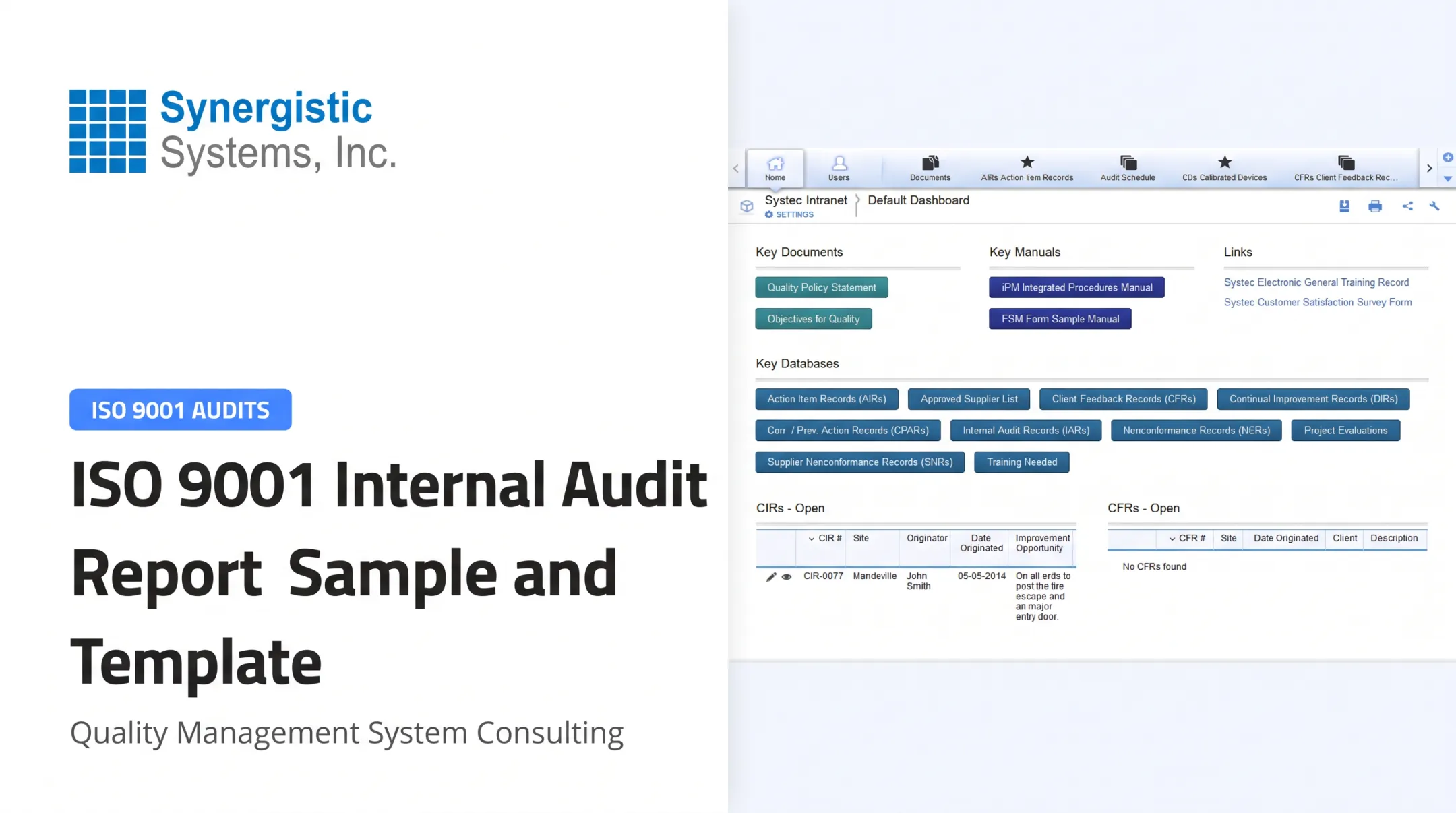
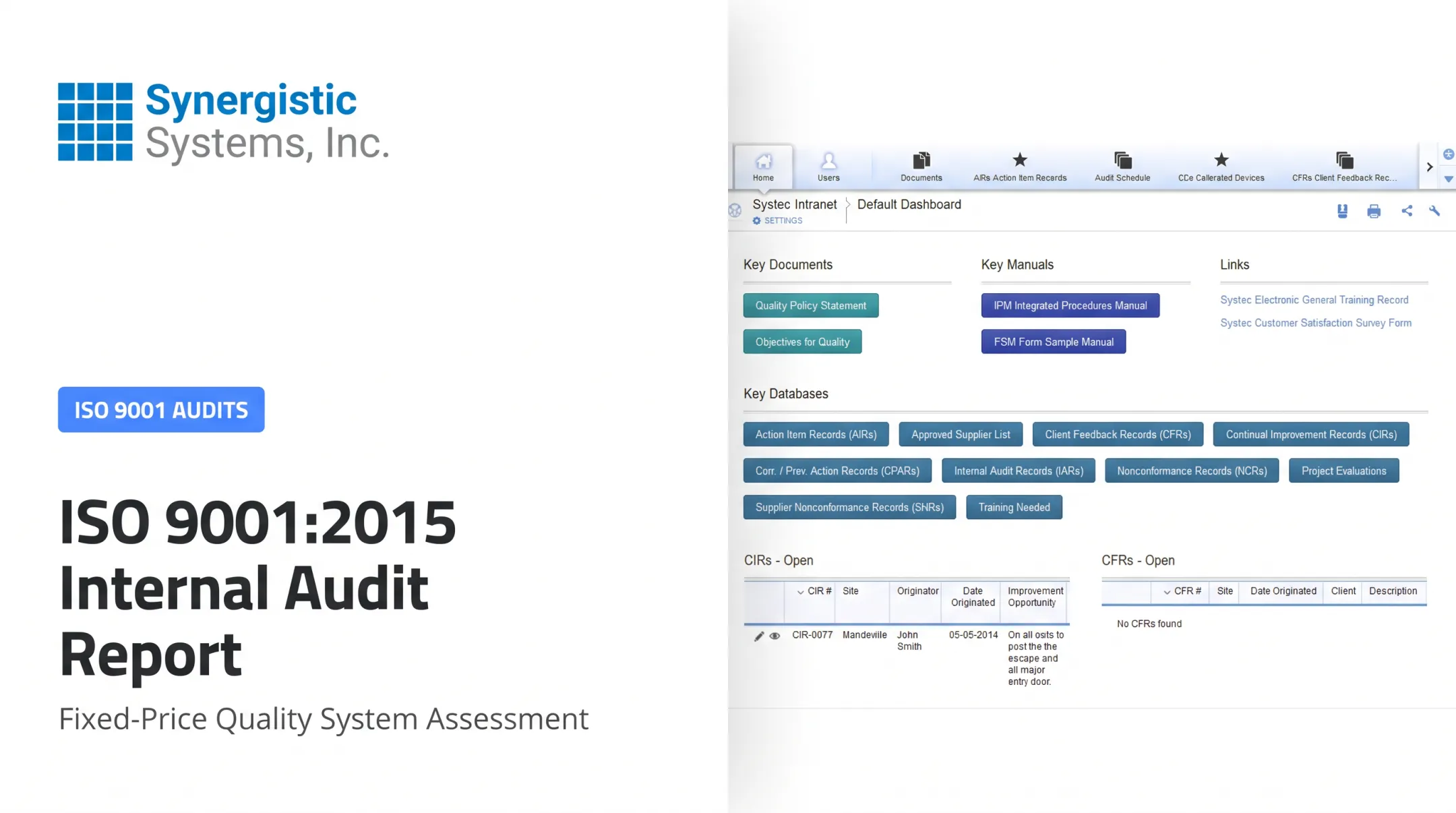
A cloud-based QMS intranet helps here. In Synergistic Systems' ISO 9001 projects, that intranet hosts controlled documents, records, audits, and corrective actions in one place, so open 8Ds and their evidence stay visible.
8D versus CAPA
CAPA is the broader corrective and preventive action process. 8D is a structured method for investigating and documenting one case within it. SAE AS13000A, for instance, uses 8D to answer a customer's request for corrective and preventive action. A CAPA system may use other methods, and a finished 8D proves nothing without verified results.
Best Practices, Common Mistakes, and Next Steps
Avoid treating the report as paperwork
Common weaknesses:
- Vague problem statements
- A symptom listed as the root cause
- Actions chosen before analysis is done
- Unsupported assumptions
- Actions with no owner or due date
- Closure right after implementation, with no effectiveness check
ISO/IAF auditing guidance on nonconformity review stresses objective evidence that corrective action was implemented and is effective before closure. It is educational guidance, not an ISO-endorsed interpretation.
Make prevention and document control part of the solution
D7 should reach similar processes, products, sites, suppliers, procedures, training, and control plans. Update controlled documented information, then confirm that affected employees understand the revised process and can follow it.
Use a simple, scalable system
Use a controlled template, a clear workflow, accessible records, and defined escalation rules. Review recurring issues periodically, especially across multiple sites. Organizations that need help turning 8D practice into QMS procedures, records, and training can consider Synergistic Systems' ISO consulting and modular documentation and training systems.

An 8D report earns its value by producing a verified, lasting solution rather than a completed form. Use it in proportion to the problem, connect it to your ISO 9001 corrective-action process, and keep objective evidence from investigation through closure.
Frequently Asked Questions
What is an 8D document?
It is the controlled record of an Eight Disciplines investigation. It captures the team, problem definition, containment, root cause, corrective actions, prevention, verification, and closure.
How do I prepare an 8D report?
Decide whether 8D fits, form a cross-functional team, and define the problem with evidence. Contain the issue, verify the root cause, implement corrective action, prevent recurrence, and confirm effectiveness before closure.
What is the difference between an 8D report and a CAPA report?
CAPA is the broader corrective and preventive action process. 8D is one structured method for investigating and documenting a significant problem within it.
Is an 8D report required by ISO 9001?
No. ISO 9001 does not mandate the 8D format. Organizations may use it as structured evidence of reaction, root cause analysis, corrective action, effectiveness review, and prevention. Customers can require it separately.
When should an organization use an 8D report?
Use it for recurring, serious, customer-related, supplier-related, complex, or cross-functional issues. Simpler isolated problems can use a proportionate corrective-action record.