Introduction
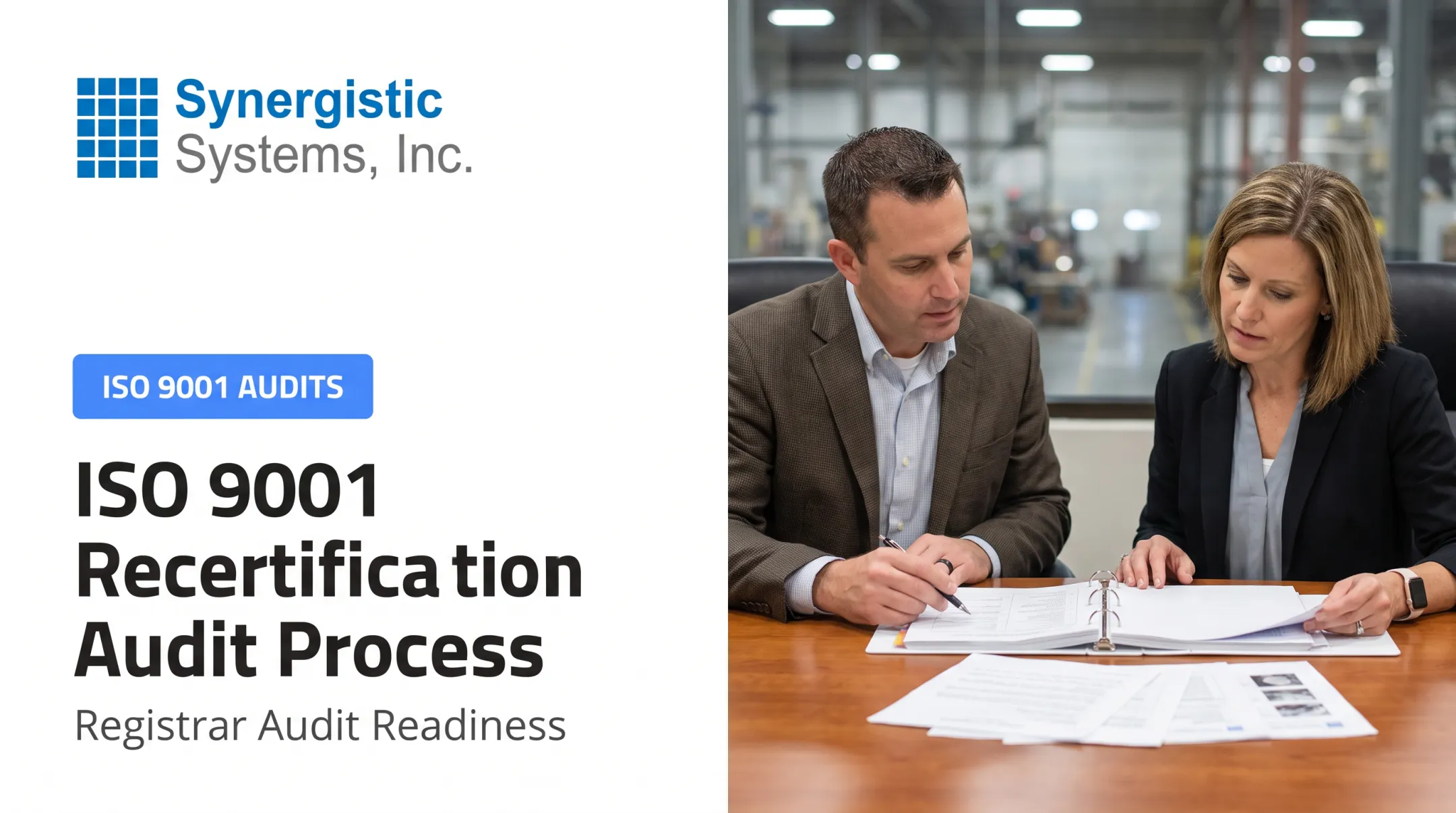
An ISO 9001 audit tests whether your quality management system (QMS) works in daily practice. Auditors check that people follow the processes and that records prove the results.
Many organizations struggle here. They write polished procedures, then discover that the shop floor or service desk does something different. Auditors find that gap quickly.
This guide covers what ISO 9001 certification means, the types and stages of audits, the evidence auditors review, how to prepare, how to respond to findings, and how to keep certification after the first decision.
Key Takeaways
- An ISO 9001 audit evaluates your QMS against the standard and your defined scope.
- Only an external certification body issues certificates; ISO does not.
- Written procedures count for little unless people follow them and records prove it.
- Internal audits, management reviews, and corrective action keep you audit-ready.
What ISO 9001 Covers
ISO 9001, the QMS, and certification
ISO 9001 sets internationally agreed requirements for a QMS. It does not prescribe how an organization must operate. ISO's own explainer describes it as supporting consistent products and services that meet customer needs and applicable regulations.
Edition matters. ISO lists ISO 9001:2026 as the current edition and the 2015 edition as withdrawn, with a three-year transition for organizations certified to 2015. Confirm which edition your certification body will audit you against.
A QMS is your organization's interconnected processes, responsibilities, controls, resources, and records for consistently meeting customer and applicable requirements. ISO 9001 is the yardstick used to evaluate it.
Why organizations pursue ISO 9001
Common reasons include:
- Showing customers a structured approach to quality
- Meeting contract or supplier expectations
- Making processes more consistent
- Clarifying who is responsible for what
- Building a habit of continual improvement
None of these is an automatic business result. The payoff depends on how seriously the system is used.
Is certification required?
Generally no. ISO states that ISO 9001 certification is voluntary. Customers, contracts, or procurement programs may still request it, and that is a commercial requirement, not a legal one.
In US federal contracting, for example, FAR 46.202-4 names ISO 9001 as an example of a higher-level quality standard. Contract clause 52.246-11 requires compliance with the standard the contract selects. It does not expressly require a third-party certificate.
What Happens During an ISO 9001 Audit?
Understand the type and purpose of the audit
ISO 19011 distinguishes three audit parties:
- First-party: internal audits, run by your own people or someone on your behalf
- Second-party: audits by customers or other interested parties of their external providers
- Third-party: independent audits, including those by certification bodies
Internal audits help you test readiness and improve the system. Only a third-party certification audit by an eligible body can support a certification decision.
Know the main certification audit stages
Certification bodies typically use two stages. NQA USA and other bodies describe Stage 1 as a document and implementation review that establishes readiness.
Stage 2 assesses conformity of the management system against the standard. Terminology varies, so confirm it with your chosen body.

During the audit, auditors:
- Confirm scope and criteria
- Sample processes and records, since time is finite and not every transaction is examined
- Interview personnel and observe work
- Compare actual practice with documented arrangements
- Trace evidence from inputs through to outputs
Understand what auditors look for
Expect requests for records such as:
- Quality objectives and process measures
- Customer feedback and supplier controls
- Competence and training records
- Production or service records
- Corrective-action, internal-audit, and management-review outputs
Auditors judge conformity and effectiveness. Documented processes are the starting point. They also want proof that people understand and use them, and that the processes deliver intended results.
Prepare employees for audit interactions
A typical audit has an opening meeting, interviews, process walkthroughs, evidence sampling, and a closing meeting. Tell employees to:
- Answer honestly and explain how they actually do the work
- Say "I don't know, I'll find out" rather than guess
- Never create records after the fact
Interpret audit findings correctly
A nonconformity is a failure to fulfill a requirement, documented with evidence and the requirement it breaches. Common categories:
- Major: affects the system's capability to achieve intended results
- Minor: does not affect that capability
- Opportunity for improvement: a suggestion; NQA, for instance, requires no response
ISO/IAF guidance also warns against relabeling an evidence-backed nonconformity as an observation. Use your certification body's current terminology, and don't assume every observation blocks certification.
How ISO 9001 Certification Works
Define the intended certification scope
Document the products, services, processes, sites, and organizational units the QMS covers, along with any justified non-applicable requirements. Clause 4.3 requires a documented scope.
Accuracy matters. An overly broad scope is hard to control. An overly narrow one may leave out customer-facing activity and misrepresent your operations.
Build and implement the QMS
The usual sequence:
- Understand context and interested parties
- Identify risks and opportunities
- Set the quality policy and objectives
- Map core and support processes
- Assign responsibilities
- Create the documented information you need
The system should fit your real work, not copy generic procedures. Involve the people who do the work. Synergistic Systems, which has run hundreds of implementations since 2000, uses collaborative documentation sessions and working sessions for exactly this reason: operational knowledge turns into usable process documentation.
Complete internal audits and management review
Internal audits should cover the full scope over a planned cycle, using impartial auditors, objective evidence, documented findings, and follow-up.
Management review is leadership's structured look at whether the QMS remains suitable, adequate, and effective. Typical inputs include context, risks and opportunities, and performance trends. Typical outputs include improvement actions, resource changes, and updates to policy or objectives. Check the exact requirements in the edition you are audited against.
Select a certification body
A consultant and a certification body do different jobs. ISO/IEC 17021-1 treats consultancy as helping establish, implement, or maintain a system. Certification must remain independent. BSI, for example, will not certify a system where another BSI Group business provided consultancy.
Choose a body with suitable competence, scope coverage, and accreditation. ANAB accredits certification bodies for competence and impartiality.
Synergistic Systems is an implementation partner offering training, modular documentation, internal audits, management review facilitation, and onsite Stage 1 and Stage 2 support. It does not issue certificates, and registrar fees are priced separately.
Maintain certification after the initial decision
After the initial decision, you keep using the system, closing findings, auditing internally, reviewing performance, and improving. Per DNV's description of accredited certification, expect periodic audits at least annually and recertification every three years. Confirm timing and rules with your certification body.
How to Prepare for an ISO 9001 Audit
Perform a structured gap assessment
Compare your current processes and evidence with the standard, your scope, customer requirements, and your own policies. Then prioritize gaps by risk and operational impact.
Give each gap an owner, resources, a due date, and a verification method. A checklist alone won't do it.
Map processes, risks, and responsibilities
Show how a customer requirement becomes a product or service: inputs, outputs, controls, measures, risks, resources, and owners. Risk-based thinking should shape real planning decisions. ISO 9001 doesn't dictate a risk method, so skip the generic risk register nobody uses.

Control documented information and records
Check that documents are approved, identifiable, available where used, protected, and marked or removed when obsolete. Records should be retrievable proof of:
- Training
- Inspections and monitoring
- Supplier evaluations
- Internal audits and management reviews
- Customer feedback and corrective actions
ISO 9001 does not require one universal document hierarchy. Use whatever format controls your processes.
Verify competence and awareness
Employees should know the quality policy, relevant objectives, their responsibilities, and how to report problems. Review qualifications, training, experience, and authorizations. Follow up where training didn't work.
A Smithers review lists recurring gap areas:
- Document control
- Corrective action
- Calibration
- Management review
- Competence evidence
- Risk-based thinking
The list is illustrative, not representative frequency data, but it is a useful checklist of weak spots.
Run an audit-readiness simulation
Run an impartial internal audit with real interviews, process tracing, record sampling, and site observation, using the scope and criteria of the external audit. Then:
- Close significant gaps
- Verify corrective action effectiveness
- Hold the management review
- Make evidence easy to retrieve
Transparent reporting of problems is stronger evidence of a working QMS than hidden nonconformities or records made for the auditor.
What Happens After the Audit?
Respond to findings with effective corrective action
Keep the terms distinct:
- Correction: eliminates the detected nonconformity
- Containment: limits further impact
- Corrective action: eliminates the cause and prevents recurrence
- Effectiveness verification: confirms the fix held
Example: a service team repeatedly ships orders with wrong documents. Correction fixes the open orders. Root-cause analysis finds a template that auto-fills outdated fields.
Corrective action fixes the template and retrains staff, and a later sample check confirms the error is gone.

Response deadlines belong to your certification body. NQA USA, for instance, sets 30 days for responses and 90 days for additional major-nonconformity evidence, but these are not universal ISO deadlines. Follow your body's process.
Turn audit results into continual improvement
Look beyond individual findings. These inputs all point to system-level improvements:
- Audit results and customer feedback
- Process measures and supplier performance
- Complaints, risks, and management-review decisions
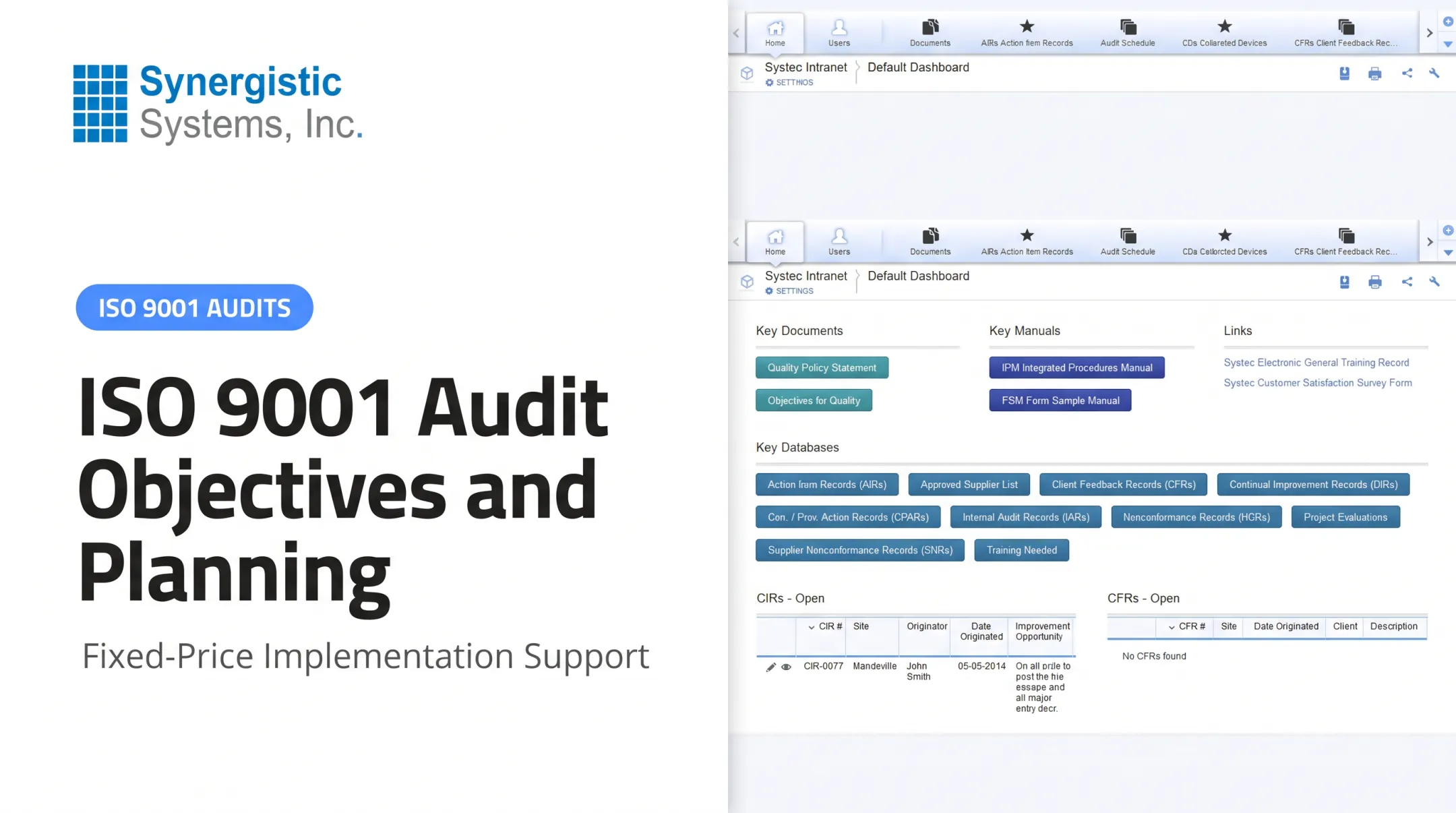
Track action owners, due dates, evidence, and effectiveness checks so actions don't stay open or recur. A cloud-based QMS intranet that hosts corrective actions and management reviews makes that tracking easier. Synergistic Systems includes this intranet in each engagement.
Manage changes and multiple sites
Changes to products, processes, people, technology, suppliers, facilities, or structure may require updates to documents, training, risk evaluations, and audit plans. Some certification bodies require notification of changes, so check your contract.
Multi-site organizations should address:
- Central processes and site implementation
- Shared records
- Internal-audit coverage
Sampling is conditional. IAF MD 1 allows sampling only when criteria are met, such as one management system, a central function, and all sites in the internal audit program. Not every program follows the same approach.
Frequently Asked Questions
What is an ISO 9001 audit?
A systematic evaluation of a QMS against ISO 9001 requirements and the organization's own processes. It relies on objective evidence from documents, records, interviews, and observed activity.
What is the ISO 9001 standard for quality management?
It specifies QMS requirements that help an organization consistently meet customer and applicable regulatory requirements and improve its processes.
Is ISO 9001 certification mandatory for all companies?
No. Certification is voluntary, though particular contracts, customers, industries, or procurement programs may require or strongly prefer it.
Is QMS the same as ISO 9001?
No. The QMS is your operating management system. ISO 9001 is the standard that sets requirements for it and is used to assess it.
What is ISO 9000 vs 9001?
ISO 9000 provides QMS fundamentals and vocabulary. ISO 9001 contains the requirements an organization can be certified against. Check current editions before citing either.
What are the different document levels in a QMS?
Common layers are policies, process procedures, work instructions, and records. ISO 9001 requires no universal hierarchy, so use the structure that controls your processes.