The practical challenge is connecting five things: role requirements, individual qualifications, competence gaps, corrective actions, and retained evidence. An auditor will ask you to walk that chain for a real person in a real role.
DNV's analysis of its 2021 QMS audits names Clause 7.2 as an area where companies frequently need to improve. Its data covers more than 100,000 findings, though DNV notes the sample isn't statistically representative worldwide.
This article covers the four requirements of Clause 7.2, implementation steps, acceptable evidence, effectiveness checks, and the audit weaknesses that come up most.
Key Takeaways
- Clause 7.2 requires you to determine competence, ensure it, close gaps, evaluate the action, and keep evidence.
- Competence can come from education, training, experience, mentoring, or licensing.
- Attendance records and certificates alone don't prove someone can do the work.
- Link role requirements to individual records, then verify with objective evaluation.
What Does ISO 9001 Clause 7.2 Require?
Clause 7.2 applies to people doing work under the organization's control whose work affects QMS performance and effectiveness. That includes employees, as well as temporary, agency, contract, or outsourced personnel. You decide which roles and activities have a quality impact.
ISO 9000:2015 defines competence as the "ability to apply knowledge and skills to achieve intended results." Job title, class attendance, and holding a certificate don't meet that definition on their own.
The clause has four requirements.
Determine the competence needed for each relevant role
Build requirements from several sources:
- Job descriptions and process responsibilities
- Customer requirements
- Legal or regulatory obligations
- Industry expectations and equipment requirements
- Internal procedures
Examples: an inspector needs measurement and inspection skills, a purchasing employee needs supplier-control knowledge, and an internal auditor needs audit competence.
Ensure people are competent
Competence can rest on:
- Formal education, licenses, or certifications
- Prior experience
- Supervised work, mentoring, or internal qualification
Often it's a mix. Compare what the person has demonstrated against what the role requires. A resume or a completed course isn't enough by itself.
Act on gaps and evaluate the action
Where competence is missing, options include:
- Training or coaching
- Mentoring or supervised practice
- Additional education
- Reassignment
- Hiring or contracting a competent person
Then decide how you'll verify the gap closed:
- Observation
- Testing
- Work sample review
- Performance results
- Supervisor sign-off
The ISO/IAF Auditing Practices Group (APG) notes that corrective actions often identify training, but training isn't the only route.
Retain documented information
Keep records showing both the requirement and how the individual met it or is progressing toward it. ISO 9001 doesn't prescribe a form, matrix, or software system. The APG guidance leaves that choice to you.
How to Implement Clause 7.2 in Your QMS
1. Identify roles and activities that need defined competence
Start with your process map, organizational structure, job descriptions, and procedures. Flag positions whose work can affect conformity, customer satisfaction, regulatory compliance, or QMS performance.
Look across departments, sites, shifts, and employment arrangements. Competence controls shouldn't stop at the quality department.
2. Create a role-based competence profile
For each role, document:
- Required knowledge and technical skills
- Education and experience
- Licenses and certifications
- Internal authorizations
- Required awareness of QMS procedures
Capture requirements by role and current status by person in a training matrix, skills matrix, or qualification register.
3. Assess current competence and find gaps
Compare each person's qualifications and demonstrated performance to the profile. Typical gaps include:
- Expired credentials
- Incomplete onboarding
- No supervised practice
- Inability to perform a required task independently
Prioritize by effect on conformity and QMS effectiveness. A gap on a final-inspection task outranks a gap on a low-risk administrative one.
4. Select actions to close each gap
Match the action to the cause:
- Missing knowledge: training
- Missing skill: mentoring or supervised practice
- Poor role fit: reassignment
- No internal capability: hire or contract
Assign responsibility, timing, and resources. Define interim controls for work done before the person is fully qualified, such as a qualified person reviewing output.
5. Evaluate whether the action worked
Set the evaluation method before the action begins. Options include:
- Practical demonstrations
- Written or verbal assessments
- Observation by a qualified person
- Review of completed work
- Evidence of consistent process performance
Record the result. Also define what happens if the action fails: more coaching, retraining, reassignment, or escalation through corrective action.
6. Keep the process current
Reassess competence after:
- Process or equipment changes
- Nonconformities or customer complaints
- Internal audit findings
- Organizational changes
- Long absence from a critical task
Modular documentation and training systems make those reassessments easier to track. Synergistic Systems helps organizations build that structure so competence controls stay current through initial implementation and ongoing QMS management.

What Documented Information Proves Competence?
Good evidence connects four things: the requirement, the person, the action taken, and the evaluation result.
Useful records
- Role descriptions and qualification criteria
- Licenses, certificates, and education records
- Resumes or experience assessments
- Training attendance and mentoring records
- Practical evaluations and supervisor sign-offs
- Authorization lists
The right set depends on your processes and risks. ISO 9001 doesn't prescribe a universal training form or retention method.
Why attendance records alone fall short
Attendance proves someone sat in the room. It doesn't prove they can perform to standard. Stronger evidence includes:
- A successful demonstration
- A completed qualification checklist
- Observed task performance
- Test results
- Fewer recurring errors
- Documented approval by a qualified evaluator
Keep evidence current and traceable
Track expiration dates, renewal requirements, procedure version changes, and requalification intervals. Define how you handle records when employees transfer roles or leave.
Link records to the role or process. Then managers can see who is qualified, who has a gap, and whether a critical activity depends on one person.

Prepare the auditor's trail
Expect these questions:
- What competence is required for this role?
- How was it determined?
- How do you know this person is competent?
- What action was taken when a gap existed?
- How was effectiveness evaluated?
Competence records fall under Clause 7.5. Per APG digital process guidance, apply controls for:
- Identification and format
- Review and approval
- Access and retrieval
- Storage and change control
Records must stay retrievable, legible, and protected from unauthorized changes.
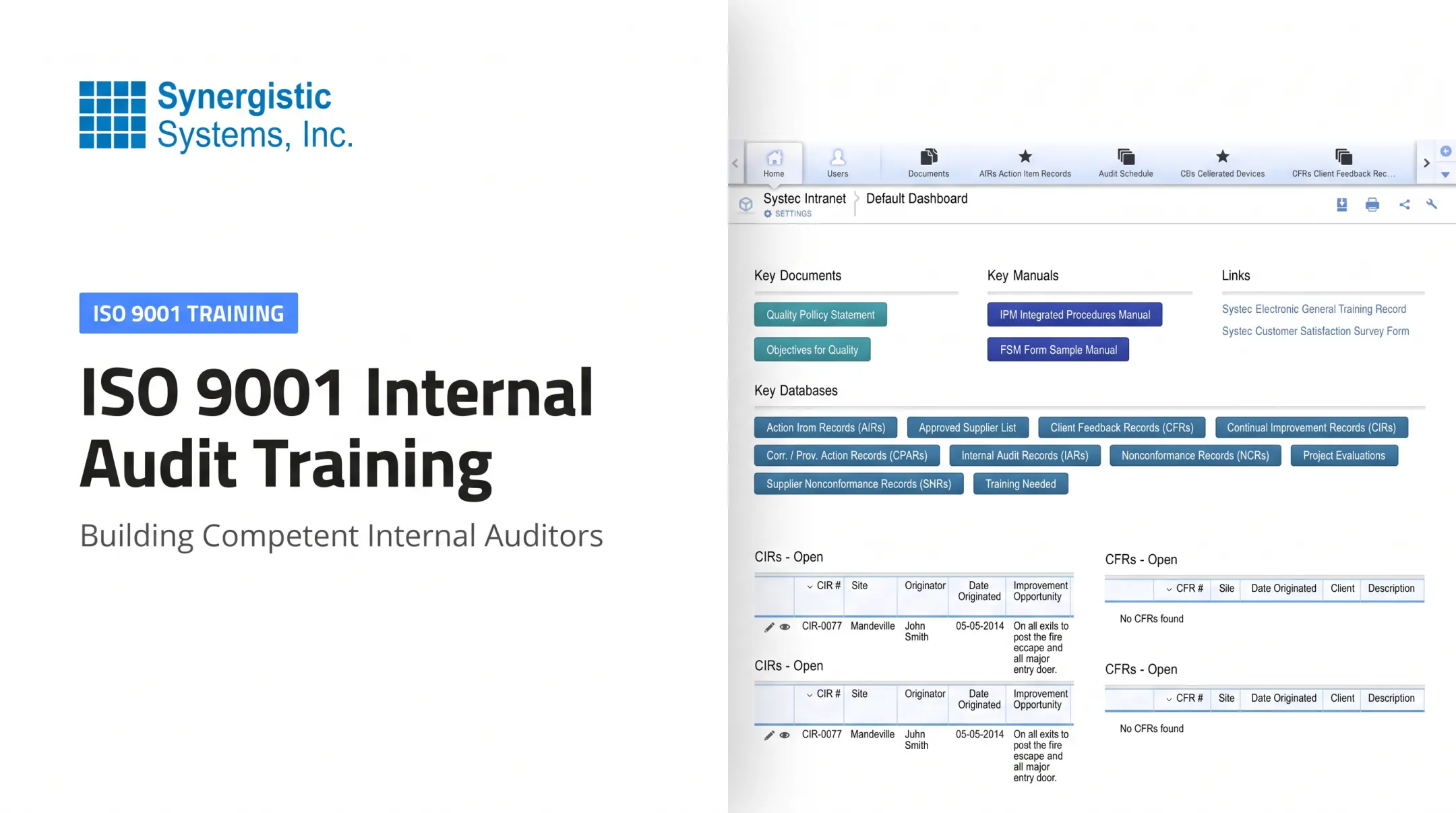
A hosted quality intranet with folder-level permissions is one way to meet this. Synergistic Systems includes that intranet in every engagement, with training records tracked alongside controlled documents.
Feed continual improvement
Internal audit results, nonconformities, customer feedback, and recurring mistakes can expose weak role requirements or ineffective training. If training isn't fixing the root cause, change the competence process, not just the course.
Common Clause 7.2 Gaps and Audit Findings
Treating competence as an annual training event
Competence must stay appropriate as people, processes, equipment, customer requirements, and procedures change. A training calendar shows planned activity. It doesn't show competence was achieved.
Holding certificates that aren't mapped to roles
An organization can own a drawer full of certificates and still be unable to show someone is qualified for the specific task they perform. Outdated, expired, incomplete, or unverifiable records make this worse.
Missing evidence for contractors, temps, and transfers
Contractor, temporary, and external provider personnel may still fall under your control. The ISO 9001 Auditing Practices Group (APG) notes that you may need to determine competence requirements and communicate them to the provider. Unclear responsibility is where gaps form.
For relevant external personnel, define:
- Competence expectations
- Who approves them
- Access controls
- Evidence requirements
How Clause 7.2 Relates to Clauses 7.3 and 9.2
Competence versus awareness
Clause 7.2 is about ability to perform work. Clause 7.3 covers awareness of the quality policy, relevant objectives, your contribution, and the implications of nonconformity, as outlined in BSI's implementation guide.
Example: a machinist may fully understand why quality matters, yet still need qualification on a specialized setup before running it alone.
How Clause 9.2 tests Clause 7.2
Internal audits determine whether the QMS conforms and is effectively implemented. Auditors can sample role requirements, individual records, training actions, effectiveness evaluations, and evidence from actual work.
The ISO 9001 Auditing Practices Group (APG) states that organizations should define internal-auditor competence requirements. Use findings to improve the competence process, not just to tidy files before the certification audit.
Connecting competence to QMS performance
Competence deficiencies tend to surface as nonconformities, complaints, rework, process variation, or missed objectives. Tracing those back to role requirements and evaluation methods closes the loop.

Frequently Asked Questions
Does ISO 9001 require training?
No. It requires that relevant people be competent. Training is one method. Education, experience, mentoring, reassignment, or hiring qualified personnel can also work.
What does clause 7.3 in ISO 9001 relate to?
Awareness: the quality policy, relevant objectives, a person's contribution to QMS effectiveness, and the consequences of nonconformity.
What is clause 9.2 of ISO 9001?
Internal audit. You plan, conduct, report, and retain evidence of audits that assess QMS conformity and effective implementation.
What records can demonstrate competence under ISO 9001 Clause 7.2?
Qualification records, licenses, certificates, experience assessments, training records, practical evaluations, mentoring records, and authorization or supervisor sign-offs.
How should an organization evaluate training effectiveness under Clause 7.2?
Measure against the intended result using observation, testing, practical demonstration, or work review. Keep objective evidence that the gap closed.